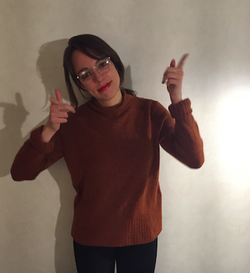
Hi, I'm Becca. I am the non-fiction book critic of the Washington Post, an editor at The Point, and a contributing editor at The Boston Review . My essay collection, All Things Are Too Small, was published Metropolitan Books in the US and Virago in the UK in April 2024. The New York Times called it "splendidly immodest" and "exhilarating" and The Guardian called it "bracing and brilliant." It was a New York Times editors' pick and a New Yorker weekly recommendation. Finally, I am also a PhD candidate (on indefinite hiatus) in philosophy at Harvard, but i remain perhaps delusionally convinced that someday I will finish my dissertation. These days I live in Washington, DC, with this person, whom I love. Here you can find all of my Washington Post pieces, which will come out each week, generally speaking.
To keep up with my writing/rantings, subscribe to my substack here. As a writer: I have contributed essays, book reviews, and the occasional art review to publications like The TLS, The Nation, The New York Times Book Review, The New Yorker, The Atlantic, Liberties, Bookforum, Art in America, The Yale Review, The Baffler, and more. These days, I write mostly for the Washington Post about non-fiction, but occasionally I write essays on fiction and whatever else for other venues. I am the winner of the first annual Robert B. Silvers Prize for Literary Criticism (see more here) and the 2023 Nona Balakian Citation for Excellence in Reviewing (see more here). In 2017, I was a finalist for a National Magazine Award in the essays/criticism category. A few authors I especially love are Joseph Roth, Italo Svevo, Henry James, Henry Green, Heinrich von Kleist, Marie de France, and Norman Rush. My agent is Anna Sproul-Latimer of Neon Literary. As a (lapsed?) philosopher: I am primarily interested in aesthetics (especially aesthetic value and its relationship to other types of value), the philosophy of love and sex, and the history of German philosophy, especially Martin Heidegger, although I have increasingly consuming secondary interests in political philosophy. In "The Good, the Bad, and the Ugly," published in The British Journal of Aesthetics, I defend aestheticism, the view that aesthetic value is sometimes a partial grounds of moral value. I describe aestheticism in more detail in a chapter in the Oxford Handbook of Ethics and Art. If I ever get around to completing it, my dissertation will be about some combination of the following: what it is to be a beautiful person, why evolutionary psychologists are wrong about human beauty, the ethics of exclusionary romantic/sexual/aesthetic preferences, and what role the state should play in ameliorating inequitable distributions of intimate "goods." I hold a first-class MPhil in the history and philosophy of science from the University of Cambridge and a B.A., summa cum laude with high honors, from Dartmouth College, where I studied philosophy & German (and cultivated an enduring distaste for fraternities). I receive many emails asking for advice about graduate school applications. I have answered some frequently asked questions on this page. As I note there, I do not consider myself an expert in how to write a successful graduate school application, and I urge all prospective grad students to consult resources online, as well as supervisors who have served on admissions committees, rather than me! Before the pandemic, I followed Hegel in regarding nature as geistlos, but now, like any good Heideggerian, I am a big fan of hiking. Here I am in the Berkshires, which I love

|
|
In recent years, it has become fashionable to claim that a person needs special license to write about herself — that she must be extraordinarily famous, unusually rich or fantastically traumatized if she is to venture one of those embarrassing indulgences, a memoir. A person who insists on documenting an uneventful life is guilty of self-importance and so, accordingly, it has become fashionable to blame the defects of a book on the defects of its genre. Common wisdom has it that a work of autobiography is by nature doomed to insularity.
In point of fact, a book is justified by its quality, not its subject. “Home/Land,” a new book by the New Yorker staff writer Rebecca Mead, does not falter by virtue of belonging to the reviled species of memoir; rather, it flails because it is insufficiently interested in the external world. Despite its many arresting images and diverting anecdotes, it reads like a very smart person’s very well-written diary.Read more here.
0 Comments
Leave a Reply. |
Archives
June 2022
Categories |
 RSS Feed